Struck string
Santoor
A hammered box zither from Kashmir, brought into classical performance.
Introduction
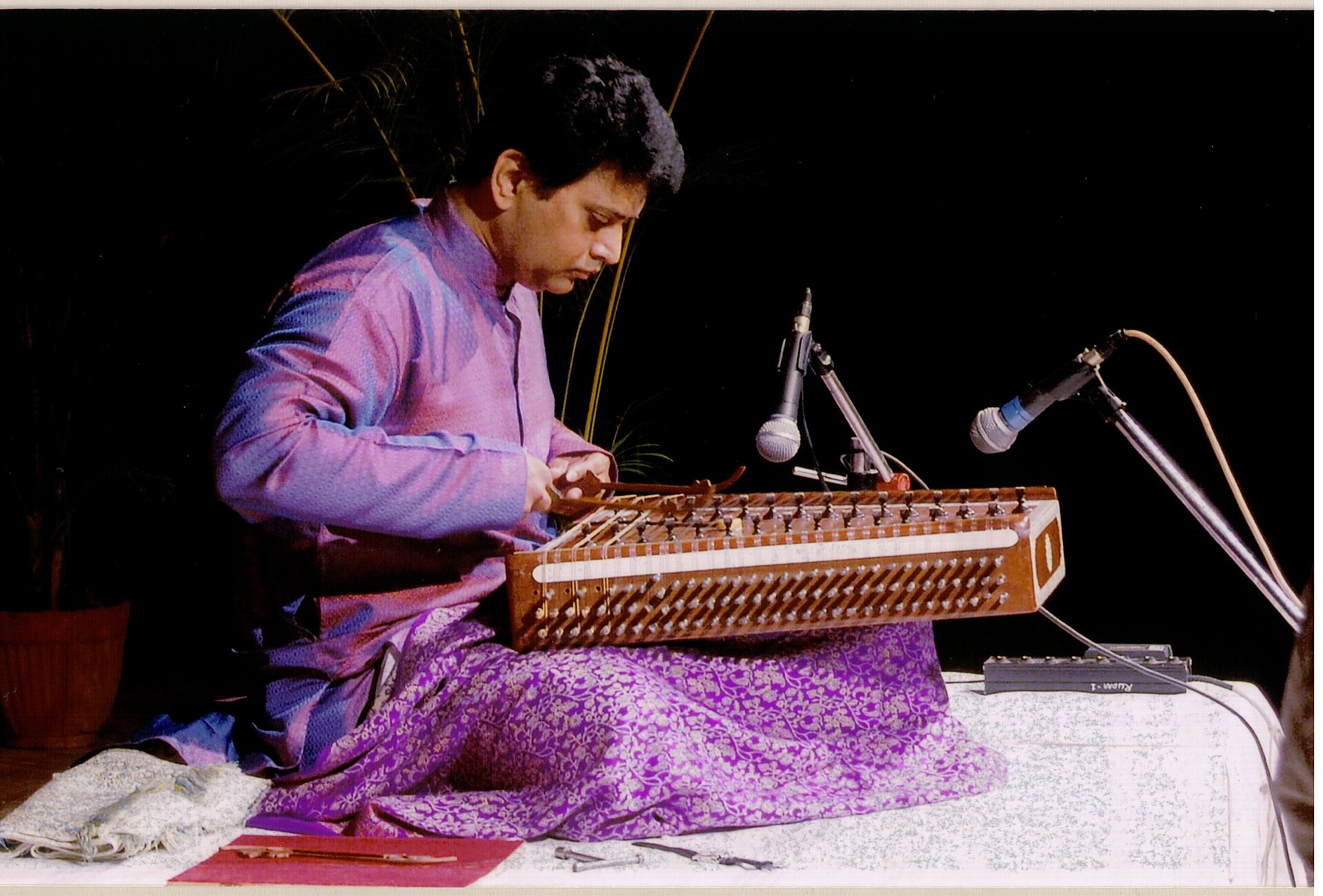
The santoor is a trapezoid wooden box strung with many courses of thin metal strings, laid flat and struck with a pair of light curved mallets called kalam. Musicologists connect it to the shata-tantri veena, the "hundred-stringed veena" of older Indian texts, and the Persian-derived word santoor likewise means a hundred strings. For centuries its living home was Kashmir, where it accompanied singers of Sufiana Mausiqi rather than appearing as a classical solo instrument.
How it makes its sound
Every note is struck, not bowed or plucked-and-bent, so it begins bright and bell-like and then decays. A santoor player cannot slide between pitches the way a sitar or sarangi player can, which is why the instrument long seemed unsuited to raag performance: meend (the glide from one note to another) and gamak (a shaken, forceful oscillation) are basic to Hindustani music and are not natural to a struck string. Players work around this with speed and control — rapid repeated strokes that hold a note alive, and carefully graded mallet weight — so the melodic line is built from a shower of individual strikes rather than an unbroken thread.
Its place in the music
In Kashmir the santoor sat inside the Sufiana ensemble, supporting vocalists, and it is still occasionally played solo there for Sufi repertoire. Its life as a Hindustani classical solo instrument is recent and largely the work of one musician. Pandit Shivkumar Sharma, son and disciple of Pandit Uma Dutt Sharma — a vocalist, tabla, harmonium and esraj player who was music-in-charge at Radio Srinagar in the early 1950s and who researched the instrument and set his son to learn it — broadcast raag performances on the santoor from Jammu and Srinagar in 1952, played the Haridas Sangeet Sammelan in Bombay in 1955 and the All India Music Conference in Calcutta the following year, accompanied there on tabla by Pandit Anokhelal Mishra of the Benares gharana. Because the santoor had no inherited body of classical gats, Sharma composed his own, drawing on his vocal training and on his earlier career as a tabla accompanist.
A short history
The instrument's Indian pedigree is traced by musicologists to the shata-tantri veena, but its documented continuous use is Kashmiri and devotional rather than classical. Shivkumar Sharma's modifications, described by his biographer Ina Puri, were physical as much as musical: Kashmiri players rest the santoor on a wooden stand, which adds a resonance he found intrusive, so he was the first to play it on the lap — roughly eight kilograms held for the length of a concert, a posture he sustained through yoga. He rebuilt the string layout with thirty-one bridges in place of twenty-five and reduced the strings from a hundred to ninety-one, which gave three clear octaves and chromatic tuning, while keeping the conventional grip on the mallets between the index and middle fingers so the tone would not change. Later players including Pandit Satish Vyas and Pandit Rahul Sharma continue from this concert tradition.
Hear it
A short sample, drawn from the instrument's most significant players, one recording each.
Start here
Raag Jog — santoor with Pandit Anindo Chatterjee on tabla
Jog · darbarfestival
Concert performance, santoor and tabla duo.
Raga Kalavati on santoor
Sony Music India Classical
Mishra Bhairavi on santoor
Darbar Festival
Explore further
Dhun in Pahadi — santoor with Satyajit Talwalkar on tabla
Pahadi · darbarfestival
References
Continue exploring
- Pandit Shivkumar SharmaPlays the santoor — a page with recordings and sources.
- Pandit Satish VyasPlays the santoor — a page with recordings and sources.
- BansuriA closely related instrument.
- Santoor traditionsThe gharanas and teaching lineages documented for this instrument.
- Gharanas & lineagesThe teaching traditions these musicians belong to.