Drone string
Tanpura
The drone instrument that holds the tonal ground of a performance.
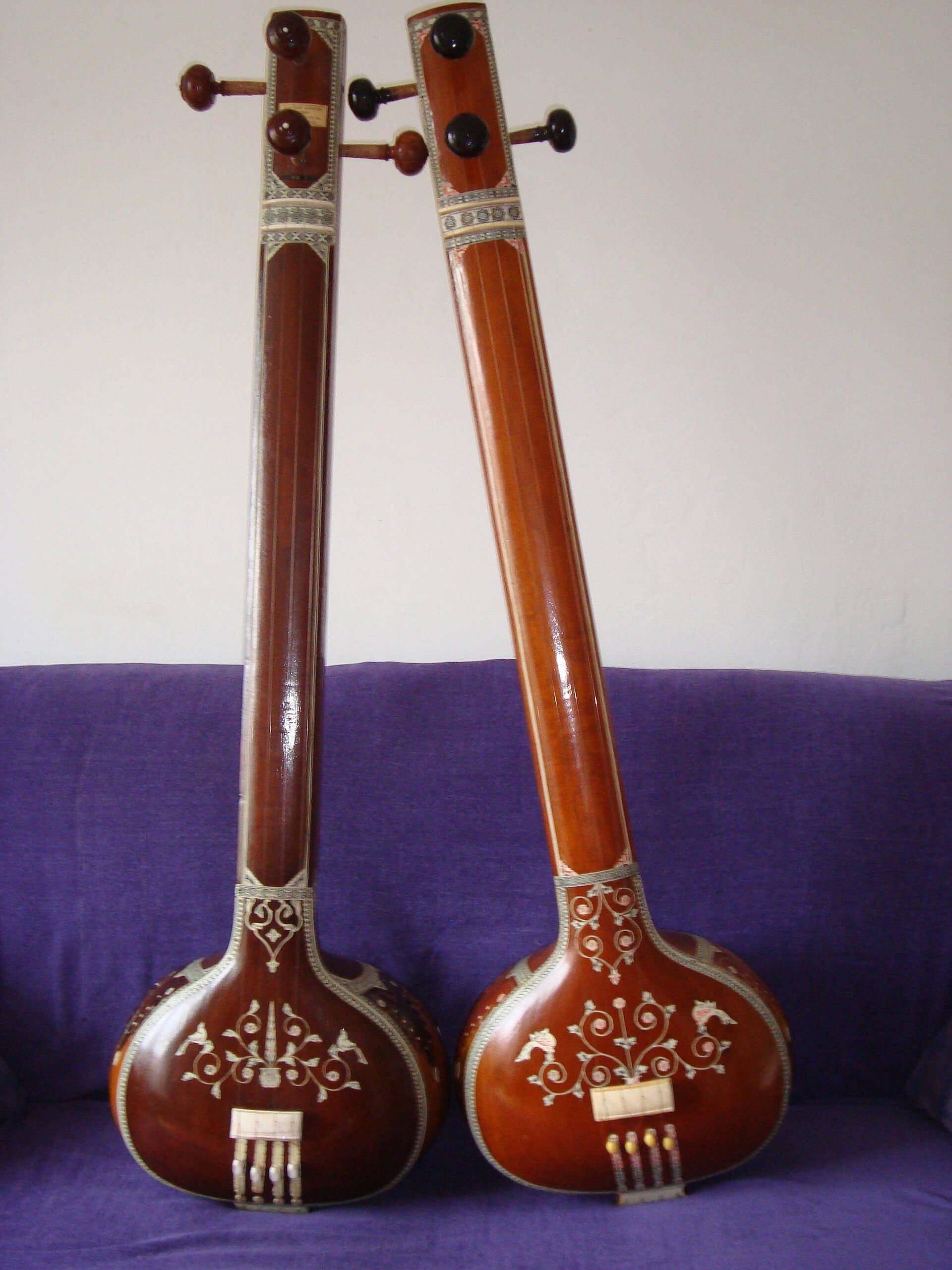
Introduction
The tanpura is a long-necked, fretless instrument, usually with four strings, played in a slow continuous cycle throughout a performance. It plays no melody and is never stopped against a fingerboard — the strings are always sounded at full length. Its body has four named parts: the tumba (the gourd or carved resonating chamber), the gulu (neck joint), the tabli or tagli (soundboard) and the dand (neck).
How it makes its sound
The tanpura's distinctive shimmer comes from jivari (also written jawari), the principle behind its bridge. The strings pass over a flat-topped, gently curved bridge whose front slopes away beneath them, so a plucked string grazes the surface intermittently rather than sitting on a fixed point. As the string's energy fades, the contact point creeps up the slope, which continuously shifts the harmonic content — a single pluck can take between three and ten seconds to complete that journey. A cotton thread slipped between string and bridge lets a player move the grazing point and tune the tonal colour itself, which is why tanpuras are adjusted to suit the intonation of a particular raag.
The standard tuning is Pa-sa-sa-Sa (fifth, two middle octaves, tonic). For raags that omit the fifth, the first string drops to the natural fourth, Ma-sa-sa-Sa; raags such as Marwa and Hindol, which omit both, call for the sixth or seventh instead. Octave strings are usually steel, the tonic and fourth or fifth brass or bronze.
Its place in the music
Every Hindustani and Carnatic performance rests on this drone, which fixes the pitch centre against which a raag is heard — an acoustic reference chord rather than a background hum. There is no absolute pitch standard in Indian classical music, so the instrument is sized to the singer: larger "male" tanpuras have an open string length of about a metre and are commonly tuned with Sa at D, C sharp or lower, while the smaller "female" instruments are around three-quarters that length and usually pitched a fifth higher. Electronic substitutes are widely used in practice, but the acoustic instrument remains the reference.
A short history
Drone accompaniment is described in the Natyashastra (roughly 200 BCE to 200 CE) without being named, and the thirteenth-century Sangita Ratnakara refers to instruments of similar function; the instrument was known in older sources as the tumburu vina, and its closest ancestor is the tritantri veena. The tanpura in its present form appears from about the sixteenth and seventeenth centuries, with early Mughal paintings showing tambur players, and seventeenth-century depictions of both an all-wooden fretless type and a wooden instrument with a gourd. Two making traditions survive: the Miraj style favoured by Hindustani musicians, built on a dried bottle gourd with tun or teak wood and a bone bridge, and the Tanjore style used in Carnatic music, carved from a solid block of jackwood with a rosewood bridge and no gourd. The instrument-making families of Miraj have been producing tanpuras for some seven generations since around 1850; a gourd is grown for the purpose and hung to dry for a year, the wood seasoned for three, and assembly takes about three weeks.
References
Continue exploring