Bowed string
Violin (Hindustani)
The Western violin, retuned and reimagined for Indian melody.
Introduction
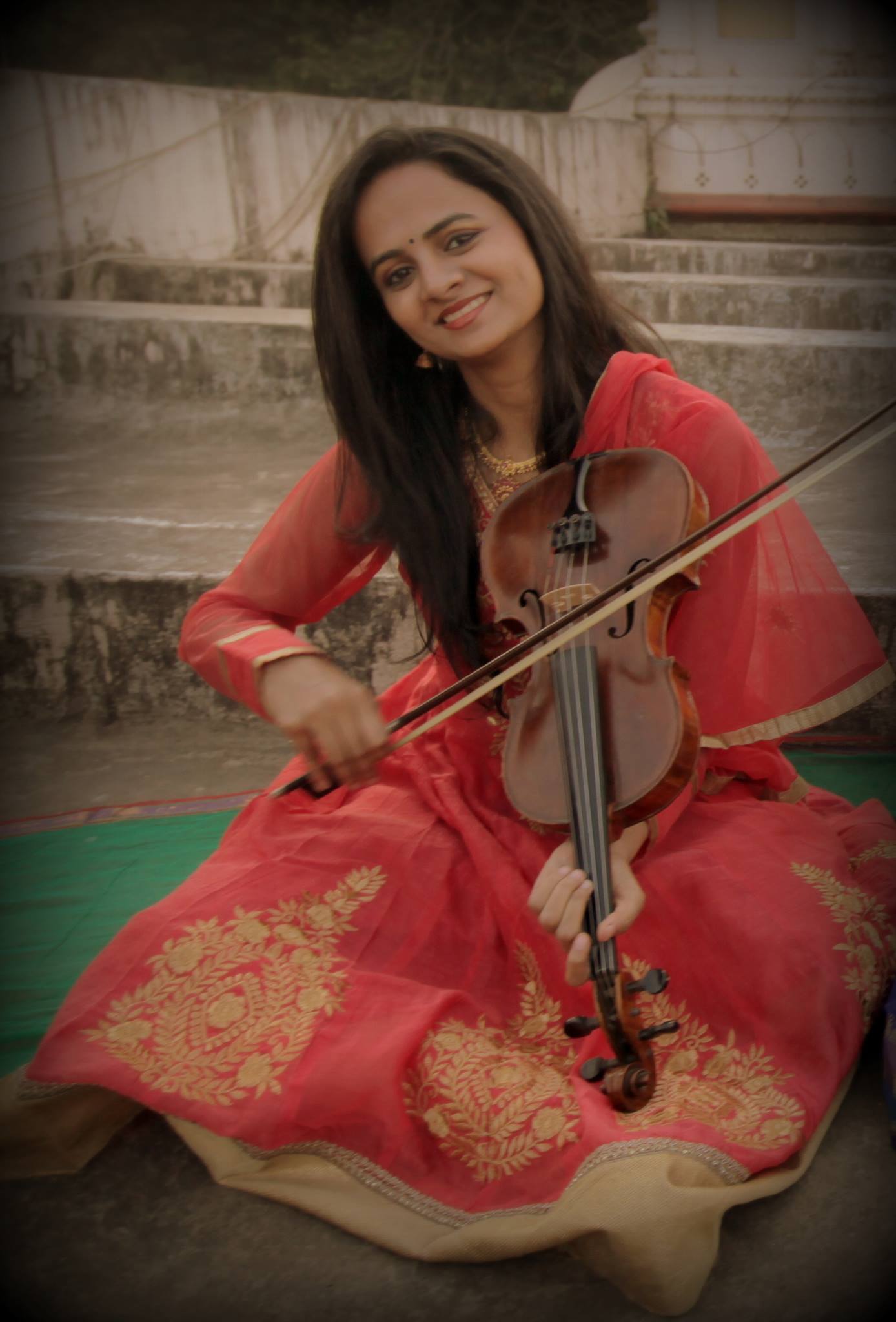
The violin is the one European instrument fully absorbed into Indian classical music. It is played in both the Carnatic and Hindustani traditions, held differently from Western practice — seated cross-legged, with the scroll braced against the ankle so the left hand can slide freely — and tuned to suit raag performance rather than to fixed fourths and fifths of orchestral use.
How it makes its sound
A fretless fingerboard and a sustaining bow make the violin unusually well matched to Indian melody: it can hold a note indefinitely, shade it, and glide between pitches without a break, which is exactly what meend and the finer ornaments require. The seated posture removes the need to support the instrument with the chin and left thumb, so the hand can travel the whole string. Tuning is relative to the chosen tonic rather than to absolute pitch, commonly in pairs of sa and pa across the four strings.
Its place in the music
In Carnatic music the violin is central to concert practice, both as the standard melodic accompaniment to a vocalist — answering and echoing phrase by phrase — and as a solo instrument. In Hindustani music it arrived later and is heard chiefly as a solo instrument with tabla accompaniment, following the usual alap–jod–gat sequence, and occasionally as accompaniment to vocalists.
A short history
The violin reached India through European contact in the eighteenth century and was taken up first in the south, where by the early nineteenth century it had been adapted to Carnatic use and passed down through families of players. Its establishment in Hindustani music was much later and is generally credited to Pandit V. G. Jog (Vishnu Govind Jog, 22 February 1922 – 31 January 2004), born in Satara district, Maharashtra. Jog began musical study at twelve, trained under the musicologist S. N. Ratanjankar and under the sarod player Allauddin Khan, and took an M.A. at the Marris College of Music in Lucknow (now the Bhatkhande Music Institute) in 1944 — one of the first institutions to formalise the teaching of traditional music. He drew supplementary training from the Gwalior, Agra and Bhendibazaar–Bakhale traditions and combined their elements into a personal style, joined All India Radio as a producer in 1953, and performed internationally, including at Carnegie Hall, Lincoln Center and Madison Square Garden. Gajananrao Joshi, a khayal singer of the Gwalior tradition who was also a violinist, represents a parallel Maharashtrian line in which the instrument was played very close to the vocal style of its player.
Hear it
A short sample, drawn from the instrument's most significant players, one recording each.
Kalavati, Bhairavi and Darbari Kanada
Kalavati; Bhairavi; Darbari Kanada · Saregama Hindustani Classical
Label release on the Saregama Hindustani Classical channel.
Start here
Raga Bhairavi on the violin
Bhairavi · First Edition Arts Channel
A solo recital recording from a concert presenter.
Darbari in Ek Taal and Teen Taal
Darbari Kanada · Saregama Hindustani Classical
Label release on the Saregama Hindustani Classical channel.
Raag Yaman for SPIC MACAY
Yaman · SPIC MACAY Eurasia
Recorded for SPIC MACAY's Anubhav series.
References
Continue exploring
- Dr. N. RajamPlays the violin (hindustani) — a page with recordings and sources.
- Kala RamnathPlays the violin (hindustani) — a page with recordings and sources.
- SarangiA closely related instrument.
- Violin (Hindustani) traditionsThe gharanas and teaching lineages documented for this instrument.
- Gharanas & lineagesThe teaching traditions these musicians belong to.