Bowed string · saurangi (a hundred colours), in the players' own folk etymology
Sarangi
A bowed instrument often said to come closest to the human voice.
Introduction
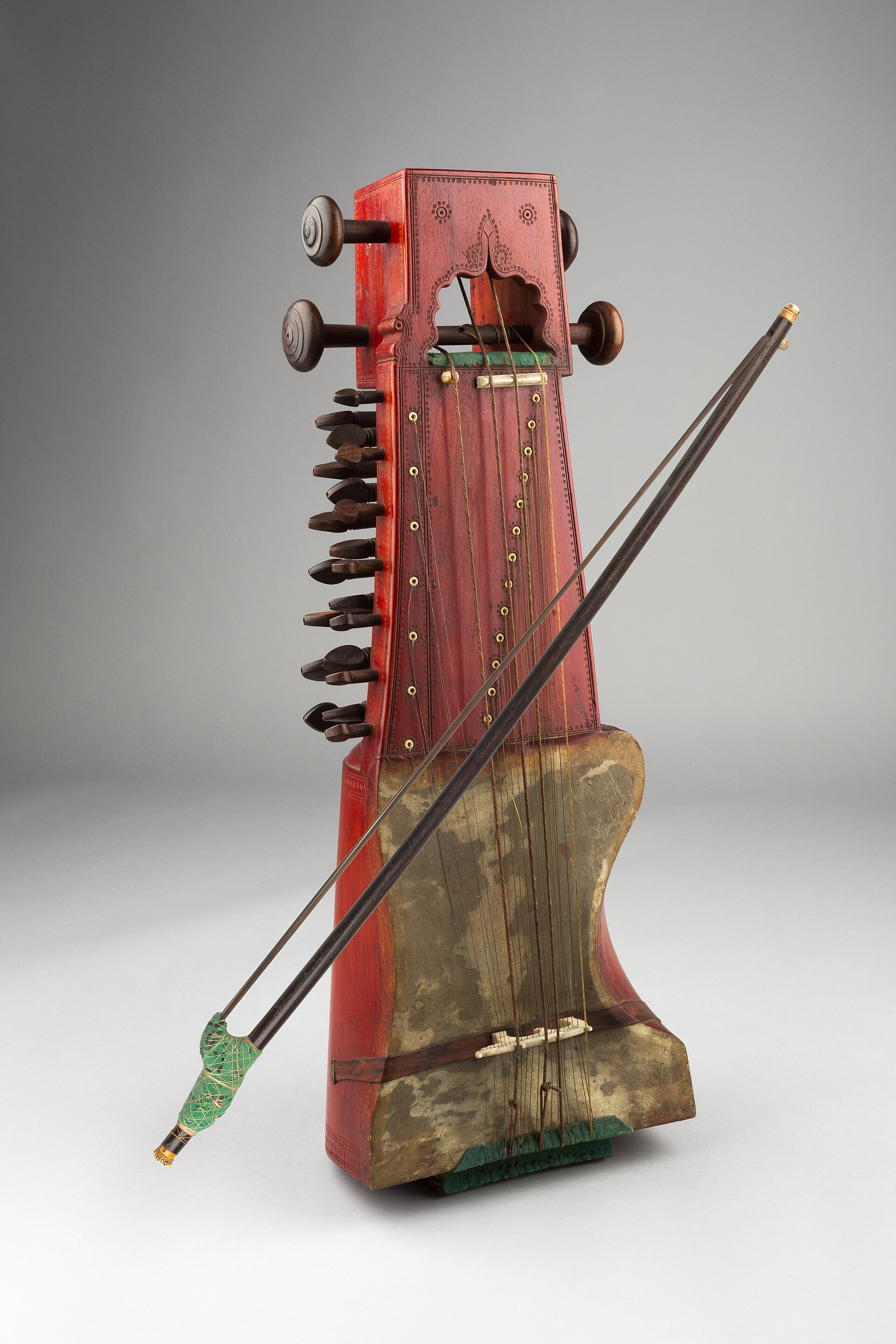
The sarangi is a short-necked bowed instrument carved from a single block of hardwood — usually tun, sometimes called Indian cedar — and is roughly 64 to 67 cm long. Its belly is covered in goatskin parchment, and an elephant-shaped bridge of bone rests on a leather strap across it. Three thick gut playing strings run over that bridge, together with around thirty-five metal sympathetic strings (tarab) tuned to the notes of the raga. Players name the three hollow chambers of the body in human terms — pet (stomach), chaati (chest) and magaj (brain) — which fits its reputation as the instrument closest to the singing voice. The name is widely explained by players as "a hundred colours", a folk etymology pointing to its range of tone and feeling.
How it makes its sound
The playing strings are stopped not with the pads of the fingers but with the cuticles and the upper nails, the hand sliding along the string rather than hopping between fixed points. Practice leaves calluses and grooves in the nails; talcum powder is used as a lubricant, and bone or ivory platforms on the neck let the fingers slide. That technique produces the unbroken glides (meend) that make the sarangi sound like a voice rather than a keyboard. The bow, held underhand, is of rosewood or ebony and much heavier than a violin bow, which adds to the solidity of the tone. Behind the melody the sympathetic strings — arranged in four groups, with a chromatic row inside and a diatonic row to the right — ring in response, leaving a dense halo of resonance after the bow has moved on. Gut strings and a parchment belly give a grainy, slightly husky sound no metal-strung instrument reproduces.
Its place in the music
For most of its documented history the sarangi was an accompanying instrument, shadowing a singer phrase by phrase in khayal and, above all, in thumri and the lighter forms — a role that tied it closely to courtesan (tawaif) performance and, later, cost it social standing. Accompaniment demanded complete musicianship: it is hard to find a sarangi player who does not know the words of many classical compositions, and a sarangi performance follows vocal conventions of structure, elaboration and pacing rather than instrumental ones. Nicolas Magriel, who has documented the tradition since 1970, argues that sarangi music is best understood as a semi-independent branch of vocal music rather than a shadow of it. Solo playing is not a modern invention either: players have always played solo at home and in musicians' gatherings, though solo sarangi reached the concert stage late. In the twentieth century it was decisively re-established as a concert solo instrument, chiefly by Pandit Ram Narayan, whose raga recitals follow the full alap–jor–jhala and bandish sequence used by sitar and sarod players.
A short history
The nineteenth-century sarangi was smaller and less standardised than the instrument played today, and Magriel suggests the complexity of the modern instrument may itself have worked against it. Several regional forms — the Sindhi sarangi and the jogiya sarangi among them — survive alongside the classical one. Its twentieth-century story is largely social. As the courtesan salons that employed sarangi players were dismantled and the imported harmonium took over vocal accompaniment, the number of players fell sharply; in Pakistan the decline is also attributed to the deaths of several masters and to the cultural climate under Zia-ul-Haq in the 1980s. Ustad Bundu Khan (1880–1955), working in Delhi, Indore and later Pakistan, was widely regarded as its greatest exponent; Pandit Ram Narayan built a soloist's career from the 1950s; Ustad Sabri Khan carried the instrument to audiences in Europe and North America and trained many players. A Sarangi Mela held in Bhopal in 1989 is credited with reviving hereditary pride in the instrument, and players such as Ustad Abdul Latif Khan and Ustad Ghulam Sabir Qadri, who had not taught their own sons, began teaching their grandsons. It remains an instrument with few exponents relative to the sitar or sarod, and much of its teaching still runs through a small number of families.
Hear it
A short sample, drawn from the instrument's most significant players, one recording each.
Start here
Teentaal — tabla solo
Akashvani AIR
A broadcaster-published tabla solo in teentaal from the All India Radio archive.
Start here
Jinke Man Ram Biraje
Malkauns · Saregama Hindustani Classical
Published on the label's own channel.
Start here
Raga Kirvani — vilambit teental
Ram Narayan - Topic
A label-distributed sarangi recording, with Suresh Talwalkar on tabla as credited on the release.
Start here
Raga Ahir Bhairav (album: Saaz Sarangi)
Ahir Bhairav · Music Today · Music Today
Studio recording issued on the album Saaz Sarangi.
References
Continue exploring
- Ustad Abdul Karim KhanPlays the sarangi — a page with recordings and sources.
- Ustad Ahmed Jan ThirakwaPlays the sarangi — a page with recordings and sources.
- Violin (Hindustani)A closely related instrument.
- Sarangi traditionsThe gharanas and teaching lineages documented for this instrument.
- Gharanas & lineagesThe teaching traditions these musicians belong to.