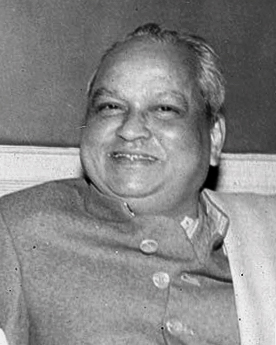
Hindustani classical · 1924–1992
Kumar Gandharva
A singer who lost six years to illness and came back with a music nobody had heard before.
- Instrument
- Khayal vocal
- Gharana
- Gwalior gharanaTrained in the Gwalior tradition; later developed an independent style
- Born
- 8 April 1924, Sulebhavi, Sulebhavi, near Belgaum, Karnataka
- Died
- 12 January 1992, Dewas, Dewas, Madhya Pradesh
- On these dates
- Sources differ on his age at death: Wikipedia gives 8 April 1924 to 12 January 1992, making him 67, while The Tribune's centenary article says he died at 68 after 44 years in Malwa.
Official website & social links
Explore Kumar Gandharva's recordings and legacy on the pages kept in their name.
These destinations belong to Kumar Gandharva or to those who look after their work, and are checked by an editor before they are listed. They leave the archive. Suggest a link or a correction.
Where to start
Begin listening
Start here
Raga Bhimpalas
Music Today
From the label release The Last Word In Hindustani Vocal, Part I.
Recordings are embedded from official or authorised channels and never rehosted. Nothing plays on its own, and starting one closes another. Where an editor has added a note, it explains why that recording was chosen — not what happens inside it.
Biography
Life
Shivaputra Siddharamayya Komkalimath was born in Sulebhavi, near Belgaum, on 8 April 1924. He was recognised as a prodigy very young and was given the title Kumar Gandharva as a boy, after a performance at about ten.
He went to Bombay to train under Pandit B. R. Deodhar, whose school was unusually open to comparative listening across styles. Kumar absorbed the Gwalior repertoire there, and also the habit of asking why a tradition does what it does.
In 1947 he was diagnosed with tuberculosis. He was told that singing could kill him, and he did not sing for roughly six years. He moved to Dewas, in Madhya Pradesh, for the dry air, and spent those years mostly in bed, listening — to the folk songs of the Malwa countryside as much as to anything else.
When he returned to the stage in the early 1950s he had lost the use of one lung and had arrived at a different music: short, high, sharply cut phrases in place of long expansive ones, and a body of work drawing openly on folk melody. He gave these hybrid pieces the name dhun-ugam ragas — ragas sprung from folk tunes.
He made Kabir's nirguni bhajans central rather than decorative, and continued composing until his death in Dewas on 12 January 1992. His wife Vasundhara Komkali, son Mukul Shivputra and daughter Kalapini Komkali all sang.
The title Kumar Gandharva was given to him as a child — a gandharva is a celestial musician in Hindu mythology — after the head of his father's family heard him sing; he was born into a Kannada-speaking Lingayat household in which his father revered the Marathi singer-actor Bal Gandharva and his elder brother sang. He was eleven when he was sent to B. R. Deodhar, and was teaching at the school before he turned twenty. The Tribune fixes the sequence of his illness precisely: the tuberculosis was detected towards the end of August 1947, four months into his marriage to his disciple Bhanumati Kans, and the couple reached Dewas on 30 January 1948, the day Gandhi was assassinated. Doctors prescribed complete rest and total silence, and the enforced maun vrat became a long period of contemplation in which the seasons of the Malwa plateau and, above all, its folk tunes reshaped his musical thinking. He stayed in Malwa for the remaining forty-four years of his life. Vamanrao Deshpande wrote in Between Two Tanpuras that where a singer usually rebuilds from phrases inherited like bricks from his teachers, Kumar "created his own bricks according to his own genius"; Govindrao Tembe called him a question mark in music, and others an exclamation mark. His biographer Raghava R. Menon wrote that he "cut Hindustani classical into two neat halves: one before Kumar Gandharva, one after him". He married Vasundhara Komkali in 1962, after Bhanumati's death the previous year.
Musical contribution
What they brought to music
Kumar Gandharva's first contribution was a question: what is a gharana for? He had the training to sing within one and chose not to, arguing that a style's value lay in what it let a singer express, not in its pedigree. The judgement was contested in his lifetime and has shaped Hindustani musical argument ever since.
The second was the material itself. He treated the folk melodies of Malwa as a serious source and traced their kinship with classical ragas, composing new ragas out of that relation. And he took the nirguni bhajans of Kabir — often placed at the end of a concert as a light coda — and made them a principal vehicle, sung with the full weight of his art.
Life in dates
Timeline
1924
Born in Sulebhavi
Born on 8 April near Belgaum, Karnataka.
c. 1934
Given the name Kumar Gandharva
Recognised as a prodigy after a performance at about ten.
1936
Begins study with B. R. Deodhar
Moves to Bombay to train at Deodhar's school.
1947
Falls ill with tuberculosis
Moves to Dewas and stops singing for roughly six years.
1953
Returns to the stage
Resumes performing with a changed voice and a changed music.
1977
Padma Bhushan
Awarded by the Government of India.
1990
Padma Vibhushan
India's second-highest civilian honour.
1992
Dies in Dewas
Dies on 12 January.
In pictures
Photographs
Lineage & company
Teachers, students and musical connections
People
Grouped by the kind of relationship the sources record — who taught this musician, who they taught, family, and the people they played with.
Teachers and gurus
- B. R. DeodharTeacher
Bombay teacher whose comparative approach shaped his thinking.
Kumar Gandharva — Wikipedia 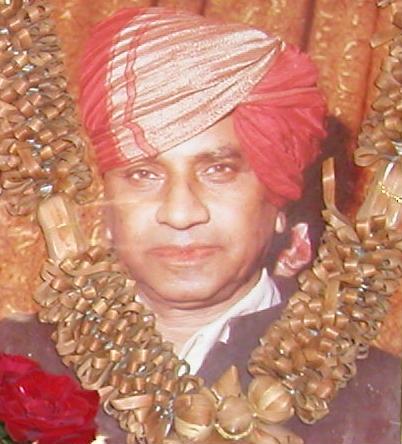 Pandit Basavaraj RajguruContemporary
Named with Rajguru among the Dharwad district musicians — Bhimsen Joshi, Gangubai Hangal, Mallikarjun Mansur, Kumar Gandharva — in Parrikar's account.
Rajan P. Parrikar, Great Masters 26
Students and disciples
Family
- Vasundhara KomkaliWife and fellow singer
Also a student of Deodhar.
Kumar Gandharva — Wikipedia - Mukul ShivputraSon and student
Hindustani vocalist.
Kumar Gandharva — Wikipedia - Kalapini KomkaliDaughter and student
Hindustani vocalist.
Kumar Gandharva — Wikipedia - Bhanumati KansFirst wife and disciple
Married in 1947; she travelled with him to Dewas after his tuberculosis was detected and died in 1961.
The Tribune — Remembering Kumar Gandharva in his centenary year
Other recorded connections
- Vamanrao H. DeshpandeCritic who wrote about him
In Between Two Tanpuras he argued that Kumar "created his own bricks according to his own genius" instead of rebuilding from inherited phrases.
ThePrint — Kumar Gandharva, the musical prodigy - Raghava R. MenonBiographer
Wrote that Kumar "cut Hindustani classical into two neat halves: one before Kumar Gandharva, one after him".
The Tribune — Remembering Kumar Gandharva in his centenary year
Recognition
Honours and recognition
Highest national honour first, then by year.
- 1990Padma Vibhushan
- 1977Padma Bhushan
- 1967Sangeet Natak Akademi Award
- 1985Kalidas Samman
Community
Memories from the community
Personal recollections, not verified history
These are memories shared by listeners and musicians. They sit apart from the sourced biography above, and an editor reads each one before it appears.
- No memories have been shared yet.
Members can share a memory of Kumar Gandharva. Sign in or create an account.
Provenance
Sources and image credits
- Kumar Gandharva — Wikipedia
- Kumar Gandharva and the khayal centenary — Frontline
- The Tribune — A musical innovator: Remembering Kumar Gandharva in his centenary year
- ThePrint — Kumar Gandharva, the musical prodigy inspired by his battle with tuberculosis & Kabir
- Wikipedia — Kumar Gandharva
Photograph via Wikimedia Commons, CC BY-SA 3.0
Continue exploring