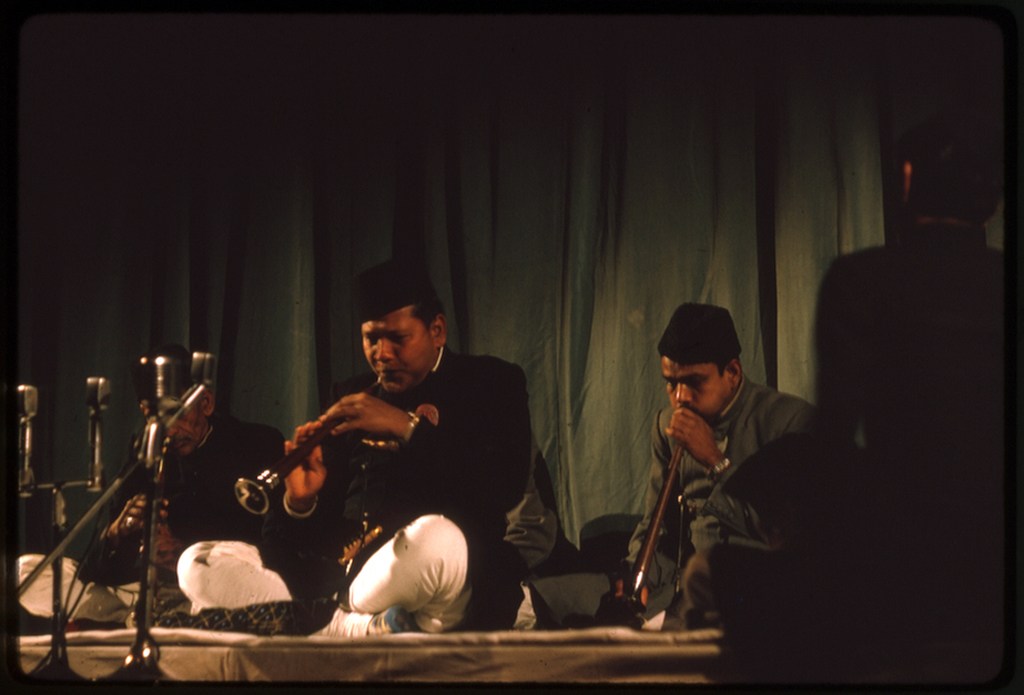
Hindustani classical · 1937–2006
Ustad Bismillah Khan
The musician who took the shehnai from the wedding procession to the concert stage.
- Instrument
- Shehnai
- Gharana
- Benares temple and Dumraon court lineage
- Schools & gurukuls
- Prayag Sangeet SamitiPerformed at the Samiti
- Born
- 21 March 1916, Dumraon, Bihar, Dumraon, Bihar, British India
- Died
- 21 August 2006, Varanasi, Varanasi, Uttar Pradesh
- On these dates
- Accounts differ on two dates. The Bharat Ratna is dated 2001 in Indian government records, but the Agence France-Presse obituary carried by The New York Times gives 1991. His Red Fort appearance is dated to 15 August 1947, the first Independence Day, in Indian accounts, while the same AFP obituary places it at the first Republic Day celebrations in 1950.
Official website & social links
Explore Ustad Bismillah Khan's recordings and legacy on the pages kept in their name.
These destinations belong to Ustad Bismillah Khan or to those who look after their work, and are checked by an editor before they are listed. They leave the archive. Suggest a link or a correction.
Where to start
Begin listening
Raga Patdeep on shehnai
Patdeep · Saregama · Saregama Hindustani Classical
Raga Kamod on shehnai
Kamod · Saregama · Saregama Hindustani Classical
Recordings are embedded from official or authorised channels and never rehosted. Nothing plays on its own, and starting one closes another. Where an editor has added a note, it explains why that recording was chosen — not what happens inside it.
Biography
Life
Bismillah Khan was born Qamaruddin Khan on 21 March 1916 in Dumraon, Bihar, into a family of court musicians of the Dumraon Raj. His grandfather Rasool Bux Khan, a shehnai player himself, is said to have greeted the newborn with the word "Bismillah", and the name stayed.
He grew up in Varanasi, where he trained with his maternal uncle Ali Bux "Vilayatu", shehnai player at the Kashi Vishwanath Temple. He first played in public in his early teens, and his performance at the All India Music Conference in Calcutta in 1937 brought him wide attention.
On the morning of 15 August 1947 he played at the Red Fort in Delhi as the Indian flag was raised, a role that tied his instrument to the story of the new nation. A devout Muslim who played at both Hindu and Muslim ceremonies, he was widely regarded in Varanasi as a figure of shared religious life.
He long declined to travel, and gave his first performance abroad only in 1966, at the Edinburgh International Festival. He played shehnai for the film Goonj Uthi Shehnai (1959) and appeared in Satyajit Ray's Jalsaghar.
He died in Varanasi on 21 August 2006, aged 90. A day of national mourning was declared, and he was buried with one of his shehnais.
His ancestors were court musicians at Dumraon, a small principality then in the United Provinces and now in Bihar. His uncle Ali Bux sat with his accompanists on the parapet beside the entrance to the Vishwanath temple, playing at once to Shiva within the precincts and to the public outside — an arrangement that, as Frontline observed, quietly negotiated a society still divided by class, caste and religion. He was twenty-one when he astonished the All India Music Conference in Calcutta in 1937, and for close to fifty years afterwards he had no rival on the instrument: other fine players worked in the same period — Ali Hussain of Calcutta, Anant Lal of Varanasi, Jagadish Prasad Qamar of old Delhi — but none matched his tone or his sense of harmonics, and he could move listener and connoisseur alike with a simple folk tune or a majestic Yaman. He attributed his gift jointly to Allah and to Saraswati. He refused repeated invitations to settle abroad, answering one offer to build him a replica of Banaras in America by saying they would not be able to bring his Ganga there, and he supported a household of some seventy dependents. He was the third musician, after Ravi Shankar and M. S. Subbulakshmi, to receive the Bharat Ratna. He died of cardiac arrest at 2.20 a.m. in a Varanasi hospital, and the government declared a day of national mourning; he was survived by five sons and three daughters.
Musical contribution
What they brought to music
Before Bismillah Khan the shehnai belonged to weddings, temple ritual and processions. He showed that it could sustain everything a classical recital demands — a slow alap, the patient exposition of a raga, the long arc of a full performance — and in doing so created a solo concert repertoire for an instrument that had none.
His tone, plaintive and vocal, is the sound most listeners in India associate with auspicious beginnings, and his career remains the clearest example of an instrument's status being changed by one player's seriousness.
Life in dates
Timeline
1916
Born in Dumraon
Born Qamaruddin Khan on 21 March into a family of court musicians.
1937
All India Music Conference, Calcutta
A breakthrough performance that brings the shehnai wide attention.
1947
Plays at the Red Fort
Performs on 15 August as the Indian flag is raised in Delhi.
1966
First performance abroad
Appears at the Edinburgh International Festival.
2006
Dies in Varanasi
Dies on 21 August, aged 90; a day of national mourning is declared.
In pictures
Photographs
Lineage & company
Teachers, students and musical connections
In the documented teaching trees
Where the archive's lineage research places Ustad Bismillah Khan, and the teaching links recorded around them inside each tree.
Benares shehnai lineage1916–2006
Made the shehnai a classical solo instrument and became one of India's most loved musicians.
Recorded as teaching: S. Ballesh
People
Grouped by the kind of relationship the sources record — who taught this musician, who they taught, family, and the people they played with.
Students and disciples
- Pandit Shailesh BhagwatDisciple
He followed the Ustad for forty years, learning at his house in Benares and on tour, and carries his rare ragas in concert.
The Hindu, 17 October 2019 - Pandit Anant LalFollowed his example
The Benares shehnai player took him as his model in bringing the instrument into classical recital; not a student of his.
Anant Lal — Wikipedia
Family
- Ali Bux "Vilayatu"Teacher and maternal uncle
Shehnai player at the Kashi Vishwanath Temple, Varanasi.
Bismillah Khan — Wikipedia - Rasool Bux KhanGrandfather
Shehnai player; said to have named him.
Bismillah Khan — Wikipedia - Kashi Vishwanath Temple, VaranasiInstitution
His uncle Ali Bux was the temple's shehnai player, and Bismillah Khan grew up playing on the parapet at its entrance.
Frontline — Khan of Shehnai
Other recorded connections
- Ustad Ali Hussain of CalcuttaContemporary shehnai player
Named by Frontline among the shehnai players of his time who had real command of technique and raga.
Frontline — Khan of Shehnai - Jagadish Prasad QamarContemporary shehnai player
Of the walled city of old Delhi; named alongside Ali Hussain and Anant Lal as a contemporary master of the instrument.
Frontline — Khan of Shehnai 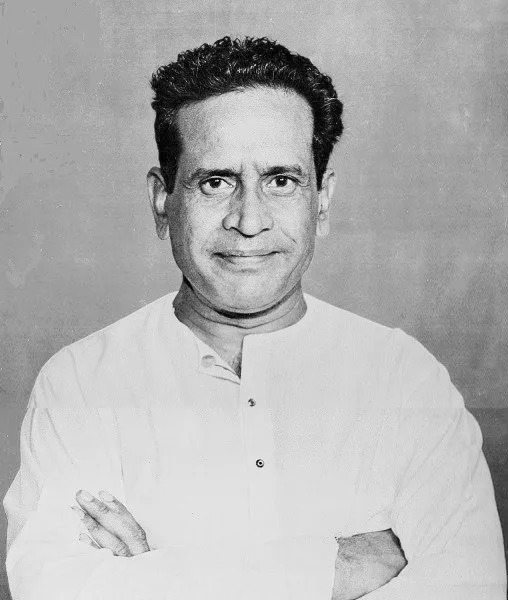 Pandit Bhimsen JoshiContemporary
Shared a room as fellow staff artistes at All India Radio, Lucknow, in 1941–42, before either was well known.
Musical genius — Frontline
Schools, gurukuls and institutions
- Prayag Sangeet Samiti
Performed at the Samiti
Recognition
Honours and recognition
Highest national honour first, then by year.
- 2001Bharat Ratna
- 1980Padma Vibhushan
- 1968Padma Bhushan
- 1961Padma Shri
- 1994Fellowship of the Sangeet Natak Akademi
- 1956Sangeet Natak Akademi Award
Community
Memories from the community
Personal recollections, not verified history
These are memories shared by listeners and musicians. They sit apart from the sourced biography above, and an editor reads each one before it appears.
- No memories have been shared yet.
Members can share a memory of Ustad Bismillah Khan. Sign in or create an account.
Provenance
Sources and image credits
- Bismillah Khan — Wikipedia
- Bismillah Khan — Encyclopaedia Britannica
- Frontline — Khan of Shehnai
- The New York Times / AFP — Bismillah Khan, 91, Indian Musician, Is Dead
- The Economic Times — Shehnai loses its master (22 August 2006)
Photograph by Robert Garfias, 1964, CC BY-SA 3.0, via Wikimedia Commons
Continue exploring