Wind
Shehnai
A double-reed wind instrument long played at weddings, temples and processions.
Introduction
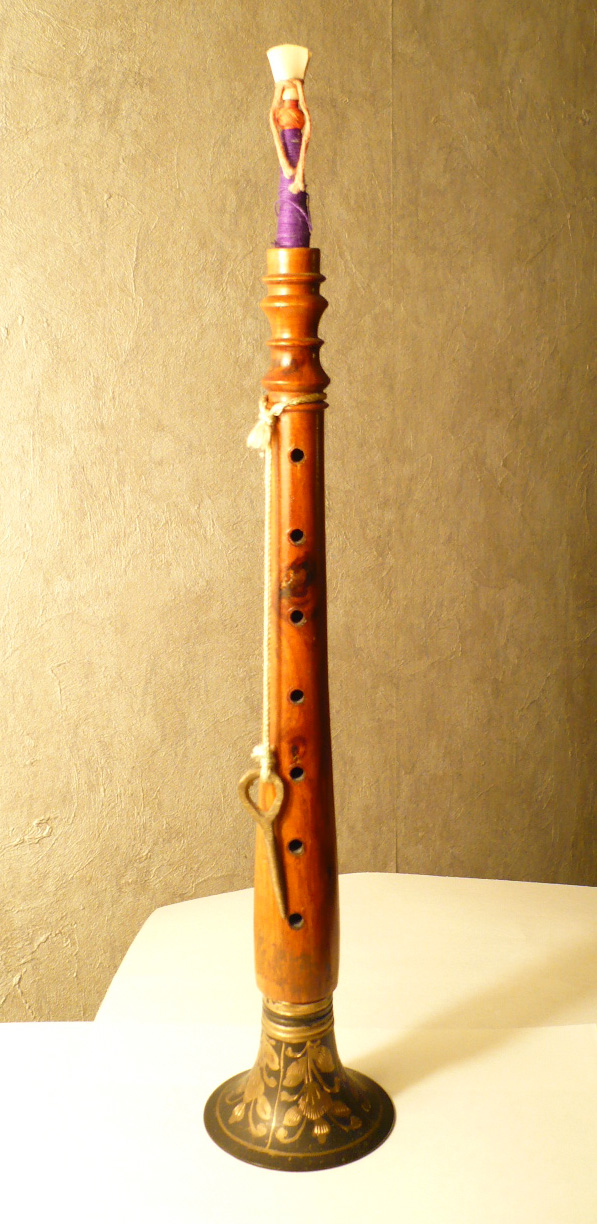
The shehnai is a double-reed wind instrument — technically a quadruple reed — with a tubular body that widens towards the lower end, usually six to nine finger holes, and often a flared metal bell. It is conventionally made of wood or bamboo, and covers about two octaves. Long associated with weddings, temples and the naubat ensembles that played at palace and shrine gateways, it was carried onto the classical concert stage in the twentieth century.
How it makes its sound
Sound is produced by a set of reeds set vibrating by the player's breath, and pitch is shaded as much by embouchure — the control of lips and breath pressure on the reed — as by the finger holes themselves. That is what lets a player bend between notes and shape the continuous glides Hindustani music needs, and it is also why the instrument is difficult: intricate lip and fingering technique must work together for every phrase. The tone is penetrating and carries outdoors, which is precisely why it belonged to processional and open-air music before it belonged to the concert hall.
Its place in the music
The shehnai's traditional role is auspicious and public: religious festivities, temple service and wedding celebrations. Along the Konkan and Goan coast, players attached to temples are called vajantri and were historically granted land for their service. Its classical career is closely tied to Ustad Bismillah Khan of Varanasi, who came from a family of court musicians at Dumraon — his father Paigambar Bux Khan served Maharaja Keshav Prasad Singh, and both grandfathers were palace musicians. He accompanied his uncle to the Allahabad music conference at fourteen and had his first major break at the All India Music Conference in Calcutta in 1937, a performance widely credited with bringing the shehnai to the attention of the classical audience. He rarely took students, believing partial knowledge was of little use; among those he did teach were Pandit Shailesh Bhagwat and Pandit S. Ballesh Bhajantri, alongside his own sons.
A short history
The instrument is generally thought to have entered India with the Mughal court, with which its use was most closely associated, and it belongs to the wider family of shawms — the surna or zurna of the Middle East, the mizmar, and the South Indian nadaswaram. Its name has several competing explanations and none is settled. A widely repeated legend holds that Aurangzeb banned the shrill pungi from his court, that a barber (nai) from a family of musicians built a longer, broader seven-holed pipe with a softer tone, and that because it was first played in the Shah's chambers by a nai it became the shehnai; a variant simply reads shah plus nai, "the king's flute". The musicologist Dileep Karanth has instead argued that shehnai is a modification of sur-nal — sur, a musical note, and nal, a pipe or reed — and that the same root underlies the surna and zurna of West Asia and Eastern Europe. Beyond Bismillah Khan, the Varanasi tradition runs through players such as Pandit Raghunath Prasanna and Pandit Rajendra Prasanna, and the Bengal line through Ustad Ali Ahmed Hussain Khan.
Hear it
A short sample, drawn from the instrument's most significant players, one recording each.
Raga Patdeep on shehnai
Patdeep · Saregama · Saregama Hindustani Classical
Start here
Bhairav to Bhairavi, part II — twenty-one raags on shehnai
1:41:35 · Pt. Rajendra Prasanna
A medley of twenty-one raags, offered in memory of his uncle and teacher Pandit Vishnu Prasanna
Published by the musician himself. The raag sequence is listed in his own description.
Watch on YouTubeUploaded 2021-08-20
Shehnai recital at the 150th Harivallabh Sangeet Sammelan, 26 December 2025
Harivallabh Sangeet Sammelan Official
Raga Kamod on shehnai
Kamod · Saregama · Saregama Hindustani Classical
References
Continue exploring
- Ustad Bismillah KhanPlays the shehnai — a page with recordings and sources.
- Pandit Anant LalPlays the shehnai — a page with recordings and sources.
- BansuriA closely related instrument.
- Shehnai traditionsThe gharanas and teaching lineages documented for this instrument.
- Gharanas & lineagesThe teaching traditions these musicians belong to.