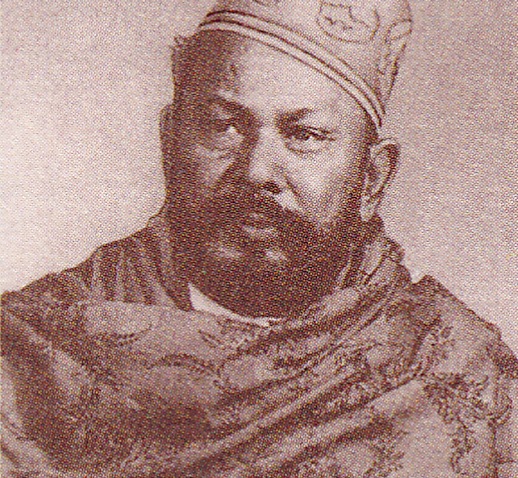
Hindustani classical · 1888–1972
Ustad Hafiz Ali Khan
Gwalior court sarodiya whose crisp, dhrupad-rooted playing and lyrical thumris made him one of the great sarod players of the twentieth century — and the father and guru of Amjad Ali Khan.
- Instrument
- Sarod
- Gharana
- Senia Bangash gharana
- Died
- December 1972
Official website & social links
We have no checked official pages for Ustad Hafiz Ali Khan yet. Suggest an official link.
Where to start
Begin listening
Gat in Raga Desh
Desh · Navras Records
One of the few recordings he allowed.
Navras Records release.
Gat in Raga Desh, with Madhavi Singh on pakhawaj
Desh · Sony Music India Classical
With the pakhawaj accompaniment he favoured.
Sony Music India Classical.
Recordings are embedded from official or authorised channels and never rehosted. Nothing plays on its own, and starting one closes another. Where an editor has added a note, it explains why that recording was chosen — not what happens inside it.
Biography
Life
Hafiz Ali Khan was born in Gwalior around 1888. His father, Nanhe Khan, was a court musician there, and the family, originally from Afghanistan, is credited with reshaping the rabab into the sarod in the time of his grandfather Ghulam Ali Khan. He learned first from his father and then from his uncle Murad Ali Khan, and later from his cousin Abdulla Khan and nephew Mohammad Amir Khan.
Looking for older, purer music, he went to Vrindavan to learn dhrupad from Pandit Chukkhelal and Pandit Ganeshilal, from the family tradition of Swami Haridas. He then studied with Wazir Khan of Rampur, a beenkar descended from Tansen's daughter's line, who pressed on him the importance of raga purity. He also learned thumri from the harmonium player Bhaiya Ganpat Rao of Gwalior.
As a Gwalior court musician he travelled often to Bengal, playing at festivals and teaching; the patrons Raychand Boral and Manmatha Ghosh studied with him. After independence and the end of the princely states, he moved to Delhi in the early 1950s at the invitation of the Bharatiya Kala Kendra. In 1948 he was photographed among the leading musicians at the first music conference after independence.
He guarded his music, recorded very little for All India Radio or record companies, and taught few students. His youngest son, Amjad Ali Khan, became his principal disciple and has described him as a strict teacher who saw music as prayer. He received the Sangeet Natak Akademi Award in 1953 and the Padma Bhushan in 1960, as well as a doctorate from Khairagarh University. He died in December 1972. India Post issued a stamp in his memory in 2000.
Musical contribution
What they brought to music
Concise and powerful: a sparing chikari in alap, the four-taan alap framework, crisp lar-lapet strokes, varied jhalas drawn from the been, elaborate Senia gats with hidden rhythmic twists, and pakhawaj accompaniment in jor. He also played lyrical thumris, which some critics felt coloured his raga music.
In pictures
Photographs
Lineage & company
Teachers, students and musical connections
In the documented teaching trees
Where the archive's lineage research places Ustad Hafiz Ali Khan, and the teaching links recorded around them inside each tree.
Senia Bangash gharana1888–1972
Court musician at Gwalior and father of Amjad Ali Khan.
Recorded as teaching: Amjad Ali Khan
People
Grouped by the kind of relationship the sources record — who taught this musician, who they taught, family, and the people they played with.
Teachers and gurus
- Pandit ChukkhelalGuru
Dhrupad, in Vrindavan
The Hindu — "The wizard of strings" - Pandit GaneshilalGuru
Dhrupad, in Vrindavan
The Hindu — "The wizard of strings" - Ustad Wazir Khan (Rampur)Guru
Beenkar of Tansen's daughter's line
The Hindu — "The wizard of strings" - Bhaiya Ganpat RaoTeacher
Thumri
The Hindu — "The wizard of strings"
Family
- Ustad Nanhe KhanFather and first teacher
Gwalior court musician
The Hindu — "The wizard of strings" - Ustad Murad Ali KhanUncle and teacherThe Hindu — "The wizard of strings"
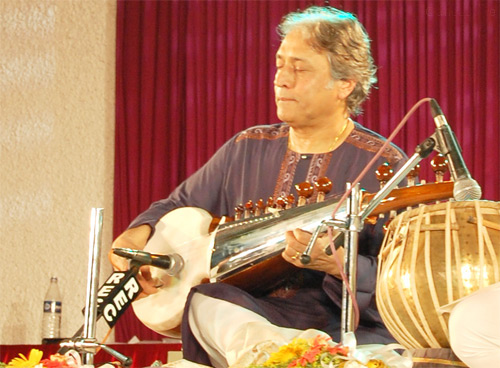 Ustad Amjad Ali KhanSon and disciple
His youngest son
The Hindu — "The wizard of strings"
Recognition
Honours and recognition
Highest national honour first, then by year.
- 1960Padma BhushanGovernment of India
- 1953Sangeet Natak Akademi AwardInstrumental music — sarod
- 2000Commemorative postage stampIssued by India Post
- Honorary doctorateKhairagarh University
Community
Memories from the community
Personal recollections, not verified history
These are memories shared by listeners and musicians. They sit apart from the sourced biography above, and an editor reads each one before it appears.
- No memories have been shared yet.
Members can share a memory of Ustad Hafiz Ali Khan. Sign in or create an account.
Provenance
Sources and image credits
- The Hindu — "The wizard of strings" (29 December 2016, archived)
- Sangeet Natak Akademi — List of Akademi awardees, sarod (archived)
- Wikipedia — Hafiz Ali Khan
- Wikimedia Commons — Indian musicians at the first music conference after independence (1948)
Photograph: Detail of the 2000 India Post commemorative stamp; Government Open Data Licence – India, via Wikimedia Commons
Continue exploring