Hindustani classical · 1899–1969
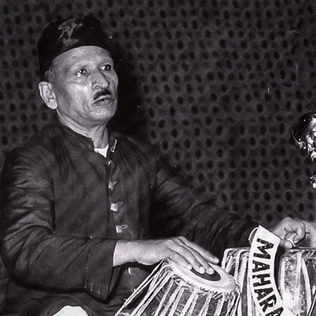
Ustad Amir Hussain Khan
The left-handed doyen of Farrukhabad tabla, nephew and heir of Munir Khan, whose compositions and Bombay school shaped generations of tabla players.
- Instrument
- Tabla
- Gharana
- Farrukhabad gharana
- Born
- October 1899, Bankhanda, Meerut district, Uttar Pradesh
- Died
- 5 January 1969
- On these dates
- Born October 1899 and died 5 January 1969 per The Oxford Encyclopaedia of the Music of India and Arvind Mulgaonkar; no source gives the place of death.
Official website & social links
We have no checked official pages for Ustad Amir Hussain Khan yet. Suggest an official link.
Where to start
Begin listening
Rupak Taal — tabla solo
Saregama Hindustani Classical
A solo from the HMV catalogue, the best starting point.
Saregama (HMV).
Tabla solo — Ektala and Roopak (AIR broadcast)
Dr. Ashok Da Ranade Archives
A long radio solo showing his compositions in two talas.
From the B. D. Kulkarni cassette collection, digitised by the Dr Ashok Da Ranade Archives, Pune. About 30 minutes.
Jhaptaal & Jhampa — tabla and pakhawaj
With Pandit Madhavrao Alkutkar (pakhawaj) · Saregama Hindustani Classical
A rare tabla–pakhawaj pairing.
Saregama (HMV). Originally HMV 78 rpm N 92589.
Recordings are embedded from official or authorised channels and never rehosted. Nothing plays on its own, and starting one closes another. Where an editor has added a note, it explains why that recording was chosen — not what happens inside it.
Biography
Life
Amir Hussain Khan was born in October 1899 in Bankhanda, a village in Meerut district. His father, Ahmed Baksh Khan, was a sarangi player who had been brought from Meerut to the court of the Nizam of Hyderabad, and he began teaching his son music at six.
The boy preferred the tabla, and his maternal uncle Munir Khan — one of the great tabla masters of his day — took over his training, first during visits to Hyderabad and later in Bombay, where Amir Hussain went to live with him. Munir Khan taught him everything he knew, including the art of composing for tabla, and Amir Hussain stayed with him until his uncle's death in 1937.
He became a celebrated performer, known for building from a slow, steady beat to an overwhelming climax. His disciple Arvind Mulgaonkar recalls that as a guest of the Maharaja of Raigarh he once played for four hours without repeating a composition. He was left-handed and played the bayan with his right hand.
From about the mid-1940s he lived in Bombay, where he founded the Munir Khan Tabla Vadan Kalalaya in Girgaum, named after his guru. His students included Nikhil Ghosh, Arvind Mulgaonkar, Pandharinath Nageshkar, Ghulam Rasul Khan, Sharif Ahmed and his son Fakir Hussain. He died on 5 January 1969. His compositions — kaidas, relas and gats — remain among the most widely taught in the Farrukhabad tradition.
Musical contribution
What they brought to music
A prolific composer whose kaidas, relas and gats form a large part of the Farrukhabad repertoire. Left-handed, he played the bayan with his right hand.
Lineage & company
Teachers, students and musical connections
In the documented teaching trees
Where the archive's lineage research places Ustad Amir Hussain Khan, and the teaching links recorded around them inside each tree.
Farrukhabad gharana (tabla)1899–1969
Teacher of a large number of leading players in Mumbai.
Taught in this tree by: Munir Khan
Recorded as teaching: Nikhil Ghosh
People
Grouped by the kind of relationship the sources record — who taught this musician, who they taught, family, and the people they played with.
Students and disciples
- Pandit Nikhil GhoshDisciple
Named among his students
Arvind Mulgaonkar — Gurus; Wikipedia — Farrukhabad gharana - Arvind MulgaonkarDisciple
Named among his students
Arvind Mulgaonkar — Gurus - Pandharinath NageshkarDisciple
Named among his students
Arvind Mulgaonkar — Gurus - Ghulam Rasul KhanDisciple
Named among his students
Arvind Mulgaonkar — Gurus - Sharif AhmedDisciple
Named among his students
Arvind Mulgaonkar — Gurus - Babasaheb MirajkarDisciple
Listed as his disciple
Wikipedia — Farrukhabad gharana
Family
- Ahmed Baksh KhanFather and first teacher
Sarangi player at the Nizam of Hyderabad's court
Arvind Mulgaonkar — Gurus - Ustad Munir KhanGuru (maternal uncle)
Trained him in Hyderabad and Bombay until his death in 1937
Arvind Mulgaonkar — Gurus - Fakir HussainSon and disciple
Named among his students
Arvind Mulgaonkar — Gurus
Collaborators and accompanists
 Ustad Ahmed Jan ThirakwaRecording partner
Shared the 1969 Odeon LP "Rhythms of India — Tabla Recital"
Internet Archive — Rhythms of India- Pandit Madhavrao AlkutkarRecording partner
Pakhawaj partner on an HMV 78 rpm disc of Jhaptal and Jhampa
Internet Archive — HMV N 92589
Community
Memories from the community
Personal recollections, not verified history
These are memories shared by listeners and musicians. They sit apart from the sourced biography above, and an editor reads each one before it appears.
- No memories have been shared yet.
Members can share a memory of Ustad Amir Hussain Khan. Sign in or create an account.
Provenance
Sources and image credits
- Arvind Mulgaonkar (his disciple) — Gurus
- The Oxford Encyclopaedia of the Music of India (2011) — "Amir Hussain Khan"
- Wikipedia — Farrukhabad gharana
- Dr Ashok Da Ranade Archives — Tabla solo, Ektala and Roopak (AIR broadcast)
No photograph of this musician is published here yet; we use only images we are permitted to show, with credit.
Continue exploring