Hindustani classical · 20th century
Ustad Munnu Khan
Delhi gharana tabla player, later khalifa of the lineage, and a principal source for the scholarly record of its genealogy.
- Instrument
- Tabla
- Gharana
- Delhi gharana (tabla)
- On these dates
- Birth and death years are uncertain. The ethnomusicologist James Kippen, who interviewed him in Delhi in April 1984, records them as approximately 1900 to 1990 and marks both with question marks.
Official website & social links
We have no checked official pages for Ustad Munnu Khan yet. Suggest an official link.
Biography
Life
The Delhi lineage traces itself to Sudhar Khan Dhari in the early eighteenth century, and is widely regarded as the oldest continuous tabla tradition. Munnu Khan stood in its senior line: his father was Chote Khan, his elder brother was Ustad Gamay Khan (1883–1958), and his nephew was Ustad Inam Ali Khan (1924–1990), who served as khalifa — the acknowledged head of the gharana. After Inam Ali Khan's death Munnu Khan is described in turn as khalifa.
Much of what is reliably known about the Delhi gharana's family tree comes through him. James Kippen, professor of ethnomusicology at the University of Toronto, collected the lineage in the early 1980s from Inam Ali Khan and from Munnu Khan, recording interviews with them in Delhi in April 1984, and worked from a genealogy written in Urdu that he was able to read directly. Kippen is candid that any such genealogy is partly selective — he calls the effect "structural amnesia", the quiet dropping of branches that no longer explain the present — and this archive records his account as the testimony of named informants rather than as documentary proof.
As a teacher Munnu Khan is named in the training of Ustad Latif Ahmed Khan, the leading Delhi tabla player of the following generation, and of Latif Ahmed Khan's son Babar Latif, who studied with him as khalifa after his father's death. His playing itself is very sparsely documented: no commercially issued recordings have been located, and his standing in the tradition rests on his position in the family, his teaching, and the knowledge he transmitted.
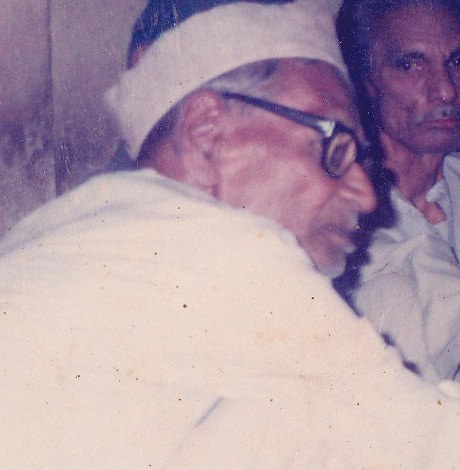
One photograph of him has survived into public view: the ganda-bandhan of the boy Babar Latif, Latif Ahmed Khan's son, in which Munnu Khan ties the ceremonial thread that binds a pupil to a teacher. It was placed online by Babar Latif himself. Outside the archive he is also named as a teacher of the sitar player Ustad Shahid Parvez Khan, who took tabla lessons from him for several years, and of the Delhi-trained tabla player Ustad Anthony Dass, who called Munnu Khan, Gamay Khan and Inam Ali Khan the three pillars of the gharana.
Musical contribution
What they brought to music
Delhi baj: the closed, two-finger technique (do ungliyon ka baaj) built on fine, even phrasing at the kinar rather than the open resonant strokes of the eastern gharanas.
In pictures
Photographs
Lineage & company
Teachers, students and musical connections
People
Grouped by the kind of relationship the sources record — who taught this musician, who they taught, family, and the people they played with.
Teachers and gurus
- Ustad Latif Ahmed KhanDisciple
Named among his teachers alongside Gamay Khan and Inam Ali Khan.
James Kippen — Delhi tabla gharana genealogy
Students and disciples
- Babar Latif KhanDisciple
Trained under him as khalifa of the Delhi gharana after his father's death.
Babar Latif — About (official site) - Ustad Babar Latif KhanDisciple
Son of Ustad Latif Ahmed Khan; continued his training with Munnu Khan as khalifa after his father's death, and published the photograph of their ganda-bandhan.
Shruti Sarita — artist profile 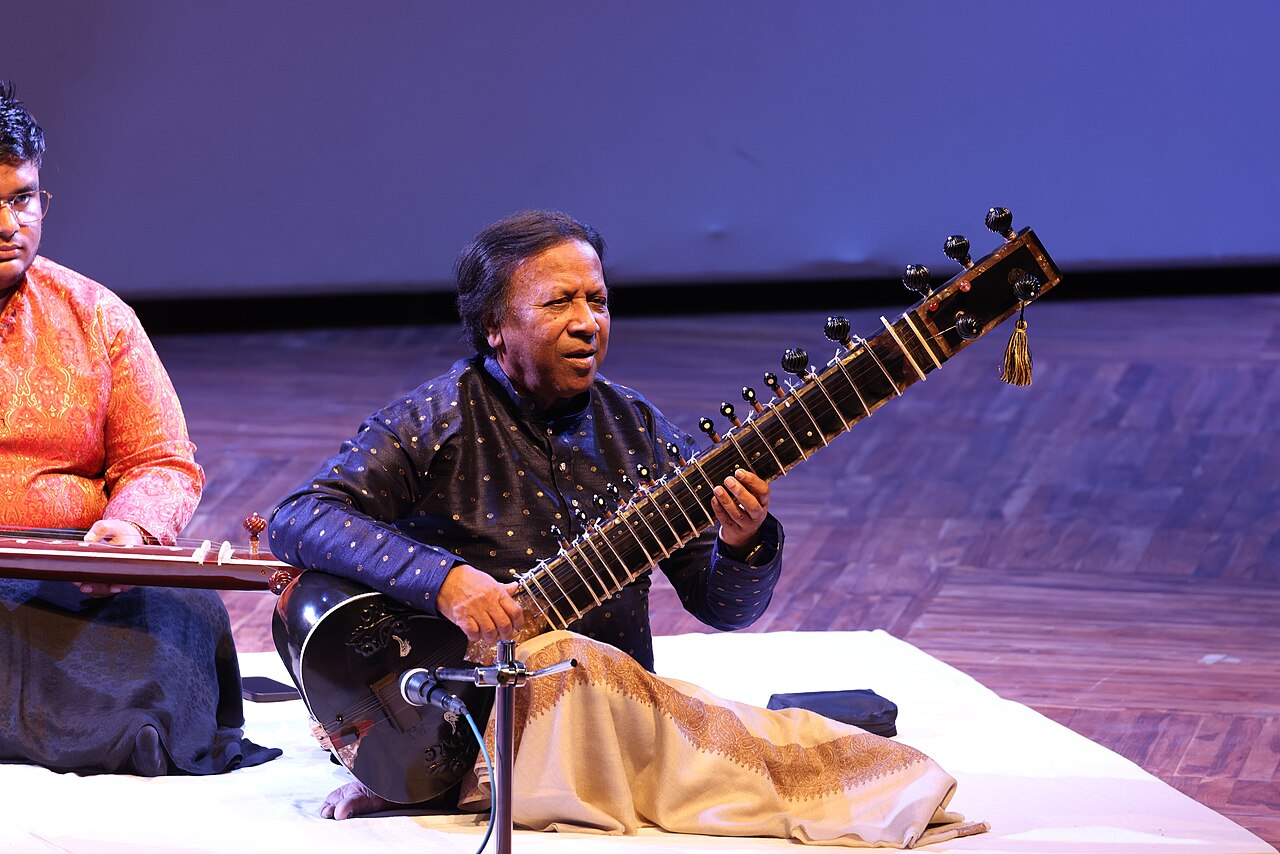 Ustad Shahid Parvez KhanStudent
The sitar player took tabla lessons from Munnu Khan over several years — a study alongside his own instrument, not a tabla career.
DooBeeDooBeeDoo NY — concert review
Family
- Ustad Gamay KhanBrother
Both sons of Chote Khan of the senior Delhi line.
James Kippen — Delhi tabla gharana genealogy - Ustad Inam Ali KhanNephew
Son of Gamay Khan and khalifa of the gharana; Kippen's other informant.
James Kippen — Delhi tabla gharana genealogy - Ustad Natthu KhanFamily connection
Related through the marriage of Wali Bakhsh Khan's daughter to Gamay Khan.
James Kippen — Delhi tabla gharana genealogy
Community
Memories from the community
Personal recollections, not verified history
These are memories shared by listeners and musicians. They sit apart from the sourced biography above, and an editor reads each one before it appears.
- No memories have been shared yet.
Members can share a memory of Ustad Munnu Khan. Sign in or create an account.
Provenance
Sources and image credits
- James Kippen, "Genealogical musings: a brief discussion of the Delhi tabla gharana" (University of Toronto; archived)
- Babar Latif — About (official site)
- Wikimedia Commons — photograph of Ustad Munnu Khan at Babar Latif's ganda-bandhan
- Tabla Glen — gallery: Ustad Anthony Dass and the three pillars of the Delhi gharana
Photograph: Detail from a photograph of Babar Latif Khan's ganda-bandhan ceremony; uploaded by Babar Latif Khan — CC BY-SA 4.0, via Wikimedia Commons
Continue exploring