Percussion · mridang; related to the older mridanga and to the South Indian mridangam
Pakhawaj
A barrel drum, older than the tabla, central to dhrupad.
Introduction
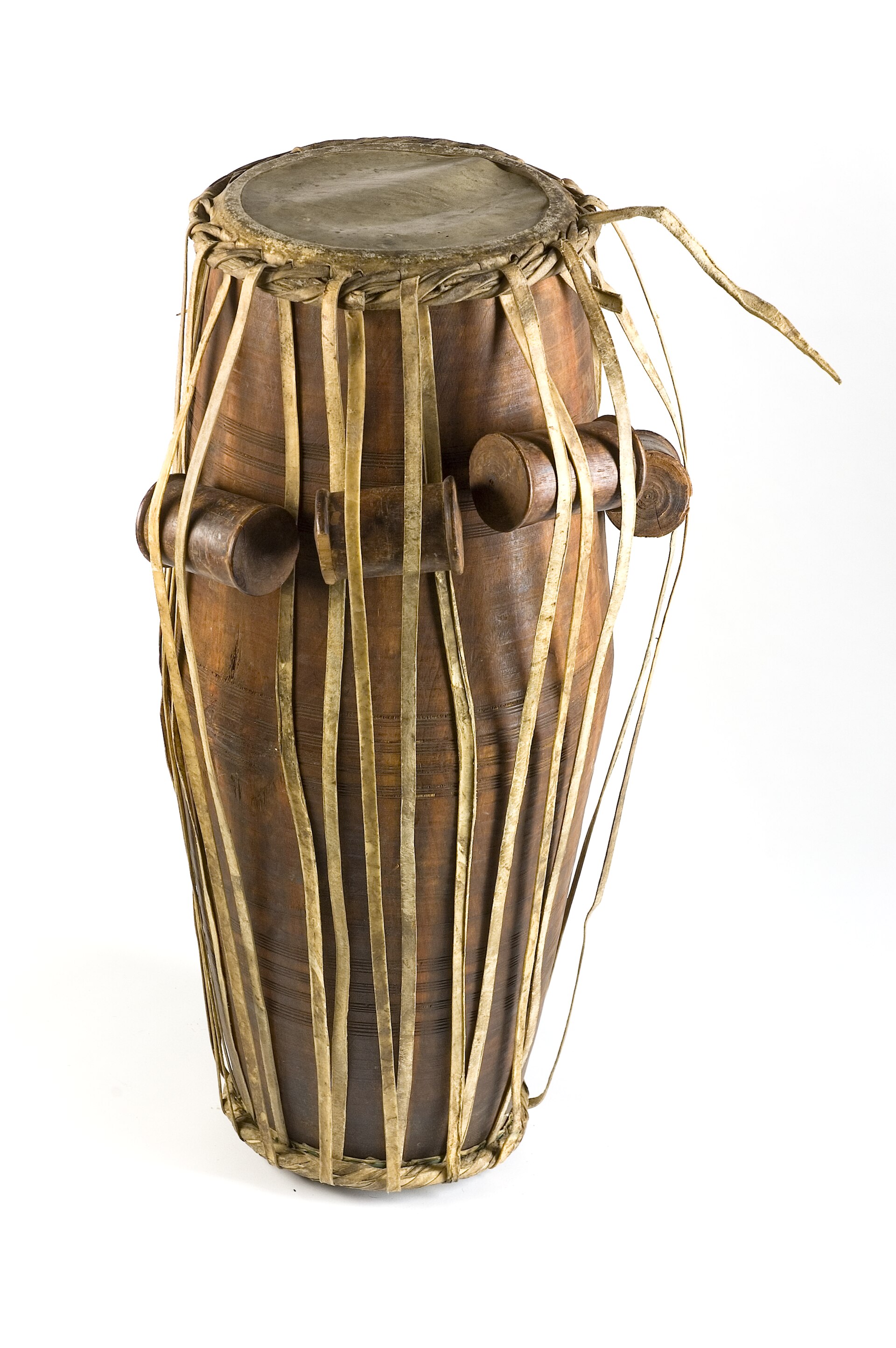
The pakhawaj is a barrel-shaped two-headed drum, laid horizontally in front of a cross-legged player who strikes the smaller treble head with the dominant hand and the wider bass head with the other. Older instruments were made of clay; modern ones are turned from a single block of wood and covered with animal skin, usually goat.
How it makes its sound
Its tone is low, dry and mellow, unusually rich in harmonics and with far less pitch-bending than the tabla. The treble head carries a permanent black paste; the bass head is smeared with a fresh dough of wheat flour and water before every performance, and stripped afterwards, which is what gives the bass its deep, resonant weight. Applying that dough well is a craft in itself. The bass side is struck with the whole palm rather than the fingers. As on the tabla, strokes are named and taught as spoken syllables, bols.
Its place in the music
The pakhawaj is the accompanying drum of dhrupad — vocal dhrupad, rudra veena, and the bass sitar known as the surbahar — because its unornamented, sustaining tone suits that music better than the tabla. It also accompanied the rabab, and it remains the mainstay of the temple song genre haveli sangeet and the main percussion for Odissi dance. It was once the preferred drum for kathak before the tabla displaced it, though some kathak dancers have returned to it. Solo pakhawaj recitals are comparatively rare, and players such as Pandit Bhavani Shankar argued publicly for bringing the instrument forward as a solo voice rather than leaving it as accompaniment.
A short history
The pakhawaj is understood as a later form of the ancient mridanga, and the name itself is Prakrit — from pakṣa, a side, and vādya, an instrument — with cognates in Telugu, Tamil and Kannada. Accounts of its change from clay to a wooden body place that shift around the fourteenth century. It is the older of the two main north Indian drums, and several tabla traditions trace parts of their repertoire back to it. Its transmission runs through distinct schools rather than one line: the Nathdwara tradition, tied to temple worship in Rajasthan and studied at length by Paolo Pacciolla, is among the best documented, and other families — the Pathaks of Banaras, the Mundes, the Kudau Singh line — maintain their own repertoire and bols.
Hear it
A short sample, drawn from the instrument's most significant players, one recording each.
Pakhawaj solo in Jhaptaal
Art And Artistes
Pakhawaj solo published by the concert producer Art And Artistes.
Pakhawaj solo — Bhavitavya 2019, Pune
Savani Events
15 September 2019, Swami Vivekanand Auditorium, MIT, Pune
Pakhawaj solo: Jhaptaal and Tilwada
Release - Topic
Label-delivered album track.
Pakhawaj solo — 142nd Harivallabh Sangeet Sammelan, 2017
Harivallabh Sangeet Sammelan
Shree Devi Talaab Mandir, Jalandhar
References
Continue exploring
- Pandit Suresh TalwalkarPlays the pakhawaj — a page with recordings and sources.
- Raja Chhatrapati Singh JudeoPlays the pakhawaj — a page with recordings and sources.
- TablaA closely related instrument.
- Pakhawaj traditionsThe gharanas and teaching lineages documented for this instrument.
- Gharanas & lineagesThe teaching traditions these musicians belong to.