Plucked string (stick zither) · bin, been, rudra vina
Rudra veena
The deep-toned stick zither of dhrupad, long treated as the most austere instrument in Hindustani music.
Introduction
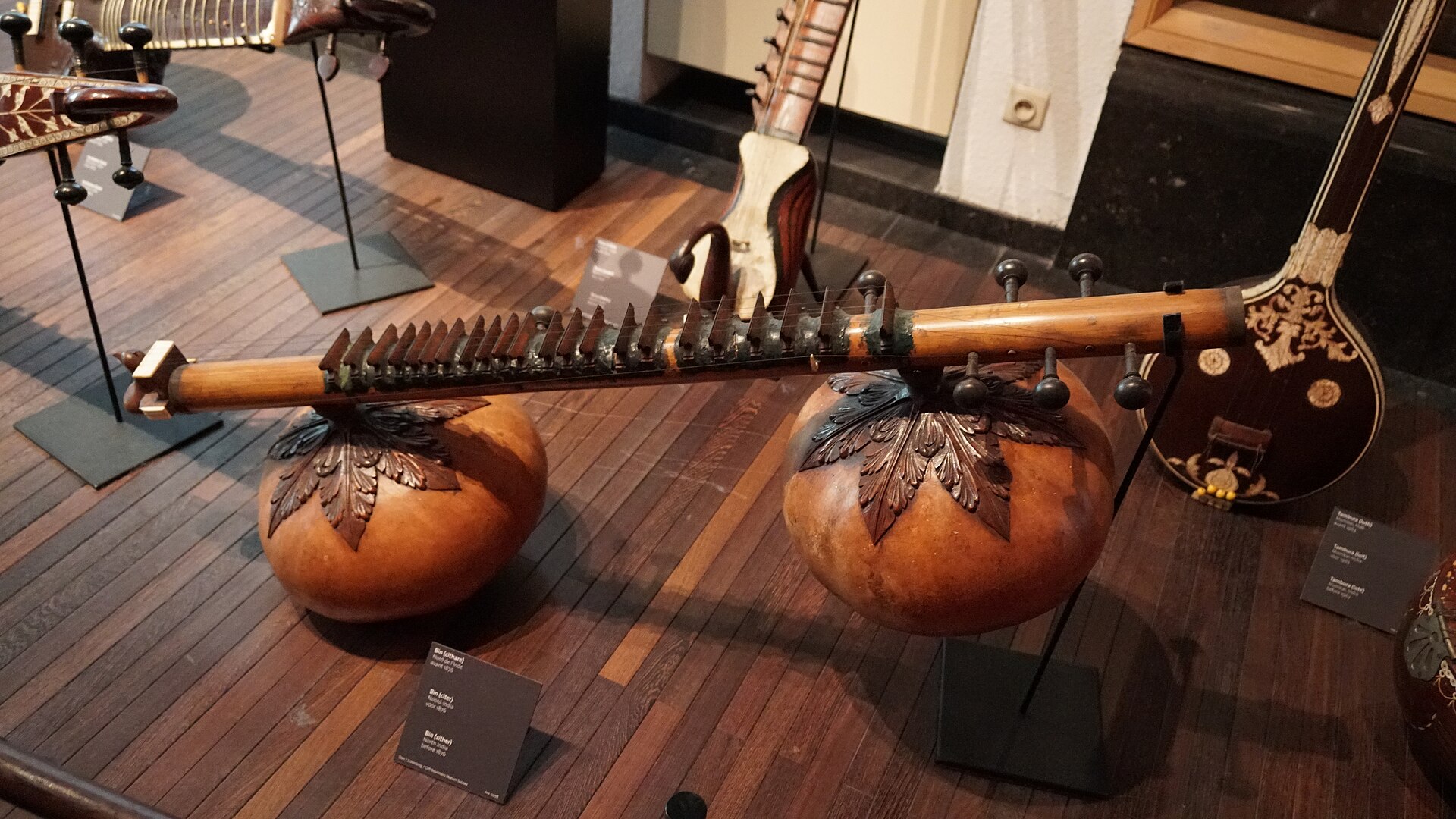
The rudra veena is a large plucked string instrument built around a long hollow tube, the dandi, of bamboo or teak, roughly 137 to 158 cm long, with two large gourd resonators (tumba) of about 34 to 37 cm mounted beneath it. It is classified as a stick or tube zither, and its north Indian vernacular name is simply bin (or been). The name comes from Rudra, an epithet of Shiva, to whom oral tradition ascribes the instrument. The lower end of the dandi is finished with a hollow carved peacock that carries the main bridge (jawari); the pegbox at the other end is a hollow carved makara. A modern instrument has seven or eight strings: four melody strings, two or three chikari strings for marking the pulse, and a low drone (laraj).
How it makes its sound
Its defining quality is bass — a deep, slow-decaying resonance with very long sustain. Twenty-one to twenty-four brass frets, each a couple of centimetres high, are tied to the dandi with waxed flax and can be shifted to the particular microtones (shruti) of a raga. Strings are plucked with wire plectra worn on the fingers and pulled sideways alongside a fret, which lets the player bend a pitch by as much as a fifth and move between notes in continuous glides (meend) rather than discrete steps. The four melody strings follow Hindustani practice of a movable tonic, tuned to the ma below the tonic, the tonic itself, the pa above it and the upper sa. All of this suits the unhurried, unmetred alap of dhrupad rather than fast rhythmic display.
Its place in the music
The rudra veena belongs to dhrupad. For much of its history it was an instrument vocalists used privately to work out melodic material rather than a concert instrument, and it was not normally played in public. Ustad Zia Mohiuddin Dagar changed that in the twentieth century, rebuilding the instrument — larger gourds, a thicker dandi, heavier steel playing strings of about 0.45–0.47 mm and a closed jawari — so that it spoke softly and deeply when plucked with the bare fingers rather than a mizrab, and performing rudra veena alap as solo concert music. It remains rare: the number of serious players worldwide is small, and several of them are not Indian.
A short history
The instrument's origin is undated. It appears in temple sculpture predating the Mughals and in court records from the reign of Zain-ul Abidin of Kashmir (1418–1470), and later held a particular place among Mughal court musicians; a portrait of Naubat Khan attributed to Ustad Mansur, around 1605, shows an early form of the instrument. Its decline began in part with the introduction of the surbahar in the early nineteenth century, which let sitar players present slow dhrupad-style alap more easily. Before independence, rudra veena players were supported as dhrupad practitioners by the princely states; when that patronage ended with the integration of the states, dhrupad's audience shrank and the bin declined with it. Its partial recovery since the later twentieth century owes much to Zia Mohiuddin Dagar's redesign and playing, and to sustained interest from musicians outside India. A related twentieth-century experiment, Lalmani Misra's shruti veena, adapted the instrument to demonstrate the twenty-two shrutis.
Hear it
A short sample, drawn from the instrument's most significant players, one recording each.
Raga Bhupali, private concert, New York 1980
Bhupali · Recorded 1980 · 30:29 · Subrata Chowdhury
A private house concert from one of his American tours, posted by a listener rather than by an official channel.
Raga Shri — rudra veena, Amsterdam 2003
Shri · 43:34 · Carsten Wicke
Concert recording published by rudra veena maker Carsten Wicke; date and venue as given by the channel.
Raag Poorvi — rudra veena
Poorvi · 7:21 · darbarfestival
Published on the Darbar Festival channel.
Start here
Rudra veena recital — DD Sahyadri, Classical Instrument, episode 31
Pakhawaj: Manik Munde; tanpura: Bhupendra Pathak and Anuratan Karkar · 27:19 · DD Sahyadri
Broadcast recording published by the state broadcaster's own channel; accompanists are named in its description.
Watch on YouTubeUploaded 2022-02-19
References
Continue exploring
- Ustad Bande Ali KhanPlays the rudra veena — a page with recordings and sources.
- Ustad Zia Mohiuddin DagarPlays the rudra veena — a page with recordings and sources.
- SurbaharA closely related instrument.
- Rudra veena traditionsThe gharanas and teaching lineages documented for this instrument.
- Gharanas & lineagesThe teaching traditions these musicians belong to.