Plucked string · Bass sitar
Surbahar
A larger, deeper-voiced relative of the sitar, used for slow alap.
Introduction
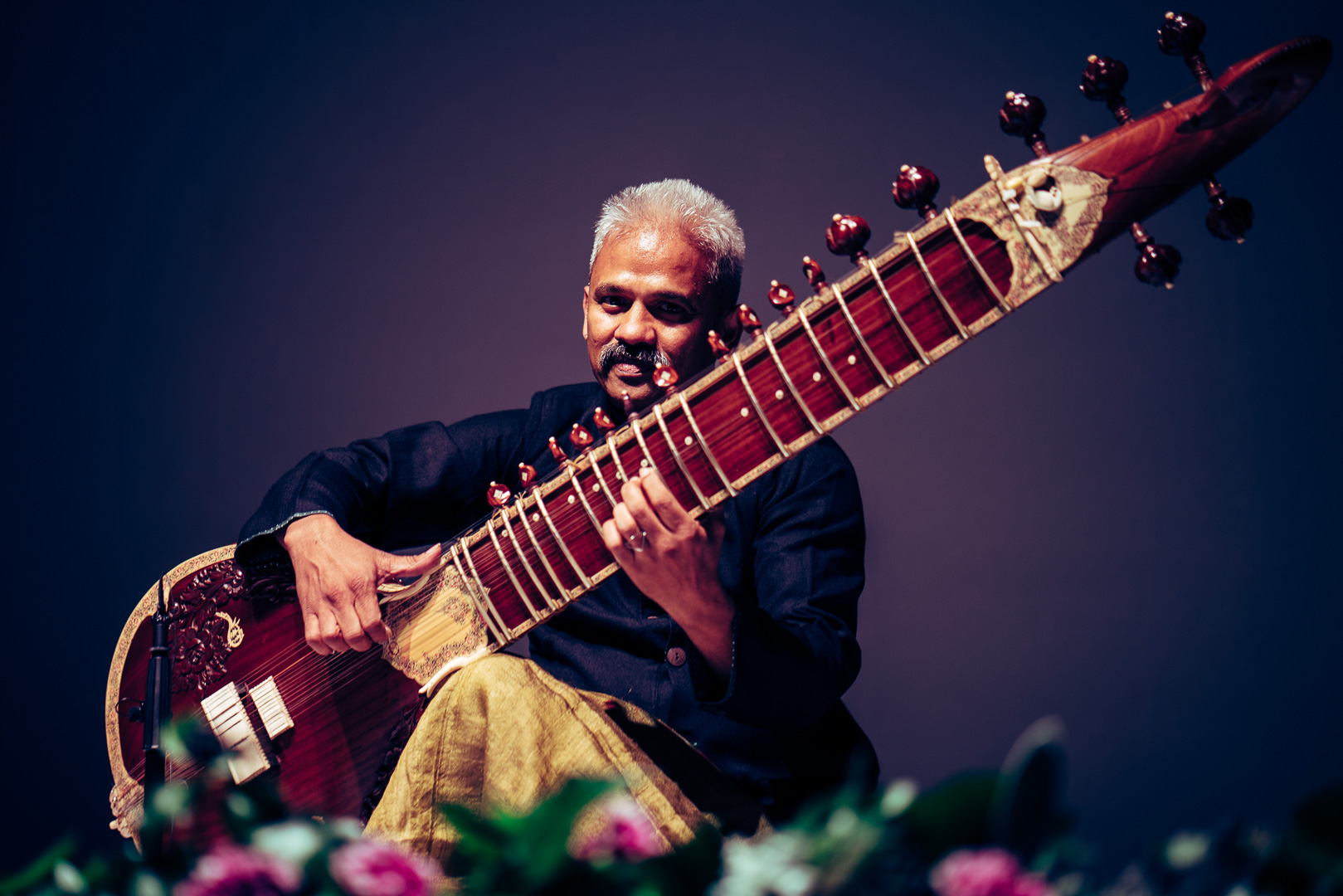
The surbahar is a large, deep-voiced plucked instrument of the sitar family, built for the unhurried opening movement of a raag rather than for fast passagework. It is sometimes called the bass sitar, and depending on its size is pitched roughly two to five whole steps below a standard sitar.
How it makes its sound
The instrument is over 130 cm long, with a dried gourd resonator, a neck of toona or mahogany, heavy playing strings (the broadest around 1 mm) and ten to eleven sympathetic strings that ring untouched. Its frets are very wide, so a player can pull a single string sideways across one fret and slide as much as an octave — the long meend that gives the surbahar its speech-like line. Three or four chikari strings supply the rhythmic drone. Heavier strings and a larger body give a slow attack and a very long decay: notes can be shaped after they are struck, but rapid figures are ill-suited to it.
Its place in the music
The surbahar is used above all for alap and jod — the sections in which a raag is unfolded note by note without tabla — where its sustain lets each phrase be examined at length. Its weight and depth are often described as closer to the dhrupad manner of the rudra veena than to sitar concert practice, and several players treat it as the instrument on which the serious exposition is done before a sitar takes over for the faster movements.
A short history
The surbahar is documented in north Indian music from the nineteenth century. Its development is generally attributed to the ancestors of the Imdadkhani sitar family — the line that produced Ustad Vilayat Khan and Ustad Imrat Khan, the latter its best-known modern exponent. Accounts of who exactly made the first instrument differ and are not settled; what the sources agree on is that it emerged in the same north Indian court milieu as the developed sitar, and that it was taken up to play repertoire in the dhrupad manner. It has always been played by a small number of musicians. Annapurna Devi, trained in the Maihar tradition, was among the most respected of them, though she performed in public only rarely, which is part of why the instrument remains unfamiliar to general audiences.
Hear it
A short sample, drawn from the instrument's most significant players, one recording each.
Sohini (qawwali ang), sitar — recorded Calcutta, 1904
The Gramophone & Typewriter, Ltd.
The first sitar recording made in India, taken by William Sinkler Darby in late 1904 and issued in 1905. Now in the public domain and held at Wikimedia Commons.
Alap in Bageshri, surbahar
Megaphone Records (JNG-25)
A 78 rpm side issued as by "Professor Enayat Khan"; the transfer is hosted on Michael Kinnear's Etawah discography page.
Raga Jaijaiwanti on sitar
Jaijaiwanti · Ustad Vilayat Khan - Topic
Yaman Kalyan on surbahar
Yaman Kalyan · 10:15 · Imrat Khan
Published on the artist's own channel. The description states he believed this to be a televised performance in Germany around the early 1980s; that date is his recollection, not documented, so no performance year is recorded.
Watch on YouTubeUploaded 2012-05-24
References
Continue exploring
- Ustad Imdad KhanPlays the surbahar — a page with recordings and sources.
- Ustad Enayat KhanPlays the surbahar — a page with recordings and sources.
- SitarA closely related instrument.
- Surbahar traditionsThe gharanas and teaching lineages documented for this instrument.
- Gharanas & lineagesThe teaching traditions these musicians belong to.